
 한국어
 English
 中文
 日本語
Seung-hwan Lee, Medical Director, Plan Me Clinic | Medical Information Column
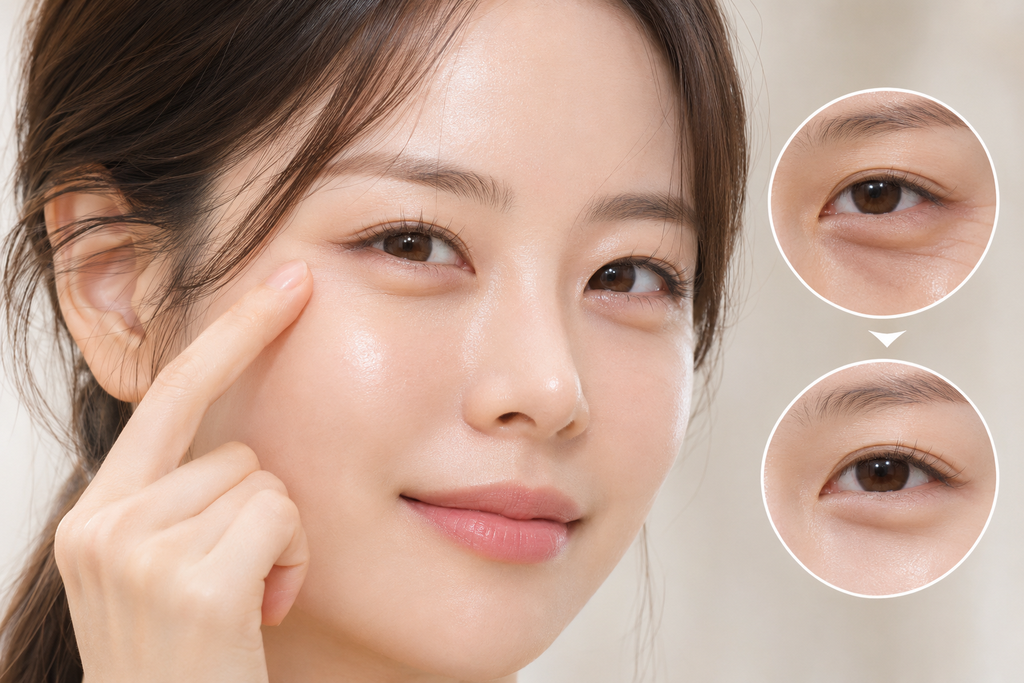
If your under-eye area looks deeply hollow and fine lines become noticeable whenever you smile, you may wonder whether under-eye filler alone is enough.
When exploring under-eye filler, you may also be advised to consider Botox around the eyes.
“If I can have under-eye filler, why would I need Botox as well?”
“Would having both make the result look more natural?”
The answer begins with the fact that under-eye hollowness and wrinkles around the eyes have different causes.
Under-eye filler supplements volume in a hollow area, while eye-area Botox softens expression lines caused by repeated muscle movement.
When both concerns are present, combination treatment may be considered. However, not everyone needs both procedures.
1. How do under-eye filler and eye-area Botox differ?
Changes associated with aging around the eyes cannot be explained by thinning skin alone.
Loss of tear-trough volume, protruding fat, reduced skin elasticity and repeated facial expressions can interact.
In particular, shadows caused by a hollow under-eye area should be distinguished from fine lines that appear when smiling.
| Feature | Under-eye filler | Eye-area Botox |
|---|---|---|
| Main purpose | Supplementing volume in hollow areas | Softening expression lines |
| Mechanism | Adding volume with hyaluronic acid | Temporarily reducing muscle contraction |
| Commonly considered concerns | Tear-trough hollowness and volume deficiency | Wrinkles around the eyes when smiling |
| Limitations | Limited ability to improve pigmentation-related dark circles | Does not fill under-eye hollowness |
Under-eye filler may help soften the tear-trough contour and reduce a dark appearance caused by structural shadows.
Eye-area Botox, by contrast, is mainly used for expression lines around the outer corners of the eyes. It does not eliminate every fine line across the under-eye area.
When Botox is considered for the lower eyelid, the function of the orbicularis oculi muscle requires particular attention. Excessive muscle weakening can affect under-eye support or the ability to close the eye.
2. When might under-eye filler and Botox be considered together?
Having both under-eye hollowness and expression lines does not automatically mean that both treatments are necessary.
However, the need for each procedure can be assessed in the following situations.
First, when the under-eye area is hollow and wrinkles at the outer eye corners are prominent during smiling.
An approach that replaces deficient tear-trough volume with filler and softens outer-eye expression lines with Botox may be considered.
Second, when the appearance of the eye area changes considerably between a neutral expression and a smile.
Contours seen at rest and wrinkles that develop with facial movement can have different causes.
Assessment should then include smiling or squinting, as well as the face viewed from the front at rest.
Third, when eye-area wrinkles are a separate concern in addition to under-eye hollowness.
Even after volume is supplemented with under-eye filler, expression lines at the outer eye corners may remain. Understanding this difference helps guide the extent of treatment.
Conversely, if hollowness is present with few expression lines, adding Botox may not be necessary.
3. Some dark circles are difficult to address with under-eye filler alone
Not every case of dark circles requires under-eye filler.
Dark circles can be broadly grouped by their causes.
- Structural dark circles: a hollow tear trough casts a shadow
- Pigmentation-related dark circles: the skin itself is darkened by melanin or other pigmentation
- Vascular dark circles: the color of vessels or underlying tissue shows through thin skin
- Mixed dark circles: several causes coexist
Under-eye filler may be considered when structural hollowness is the main cause.
If pigmentation or visible vessels are the main contributors, filler alone may not produce the desired change.
When under-eye fat protrudes significantly or the skin is markedly lax, another approach may be more suitable than filler.
At Plan Me Clinic, we place importance on distinguishing hollowness, protrusion, skin thickness and surrounding tissue condition before focusing on the dark color alone.
4. Planning the contour matters more than volume alone for natural-looking under-eye filler
One common concern about under-eye filler is that the area may look bulging or unnatural afterward.
Under-eye skin is thin, so even small changes in volume can be noticeable.
The balance of the whole face therefore matters more than simply adding a large amount to a hollow.
At our clinic, we assess the boundary between the under-eye area and front cheek, differences between the two sides, skin thickness and movement with facial expression when deciding whether and how extensively to treat.
Filler placed close to the skin surface or in excessive amounts can produce bluish discoloration known as the Tyndall effect, swelling or an uneven contour.
Rarely, vascular occlusion can cause serious complications such as skin necrosis or vision damage. Careful treatment with attention to anatomy is therefore necessary.
A natural-looking approach does not simply mean using less filler. It begins with assessing whether filler is appropriate, then selecting a suitable location and amount.
5. Can under-eye filler and eye-area Botox be performed on the same day?
The two procedures may be performed on the same day at the clinician’s discretion.
However, their sequence or interval may be adjusted according to the treatment sites, existing filler, skin condition, orbicularis oculi function and the possibility of swelling.
Under-eye filler can cause temporary swelling, bruising and tenderness. Botox around the eyes can also cause bruising or discomfort at the injection sites.
Depending on the injection site and dose, Botox can also cause facial-expression asymmetry, eyelid drooping or changes in eye closure.
In particular, sudden severe pain, changes in skin color, blurred vision or other vision problems after under-eye filler require immediate emergency medical care.
More important than deciding whether to combine the procedures is understanding which current concern each treatment is intended to address.
6. What should be checked before an under-eye filler consultation in Seolleung?
Small changes beneath the eyes can affect the overall impression of the face, making careful assessment of treatment suitability important.
At Plan Me Clinic, an under-eye filler consultation considers not only the depth and location of hollowness, but also its connection with the front cheek, skin condition and any protruding under-eye fat.
The need for eye-area Botox is also assessed by examining the location of wrinkles and the movement of the expression muscles.
Rather than automatically performing filler and Botox because the under-eye area looks hollow, it is important to consider situations in which no procedure may be the more appropriate choice.
Under-eye filler and eye-area Botox do not have to be performed together. They address different causes, so the current condition of the eye area should guide whether either treatment alone, or both, is appropriate.
If you are exploring under-eye filler near Seolleung Station, start by assessing the cause of the dark appearance rather than deciding on a procedure or injection amount first.
KakaoTalk consultation
Frequently asked questions
Do I always need eye-area Botox with under-eye filler?
No. Filler addresses deficient volume, while Botox addresses expression lines caused by muscle movement. If hollowness is present without significant expression lines, Botox may not be needed. An examination should determine whether either treatment is suitable.
Can under-eye filler and eye-area Botox be performed on the same day?
They may be performed on the same day at the clinician’s discretion. The treatment sites, existing filler, skin condition, eye-muscle function and risk of swelling can affect the sequence or interval.
Can under-eye filler improve every type of dark circle?
No. Filler may be considered when structural hollowness is the main cause. Pigmentation, visible vessels, prominent under-eye fat or significant skin laxity may require a different approach.