 한국어
 English
 中文
 日本語
Have you noticed that one eye looks particularly small in photographs, or that the eyelid crease looks different on the right and left?
Your creases may once have looked similar, yet at some point one began to look narrower and became less visible even with your eyes open.
It is easy to assume at first that you slept in an awkward position or are tired. But if the crease on the same side remains narrower over time, it is worth assessing structural changes in the eyelid.
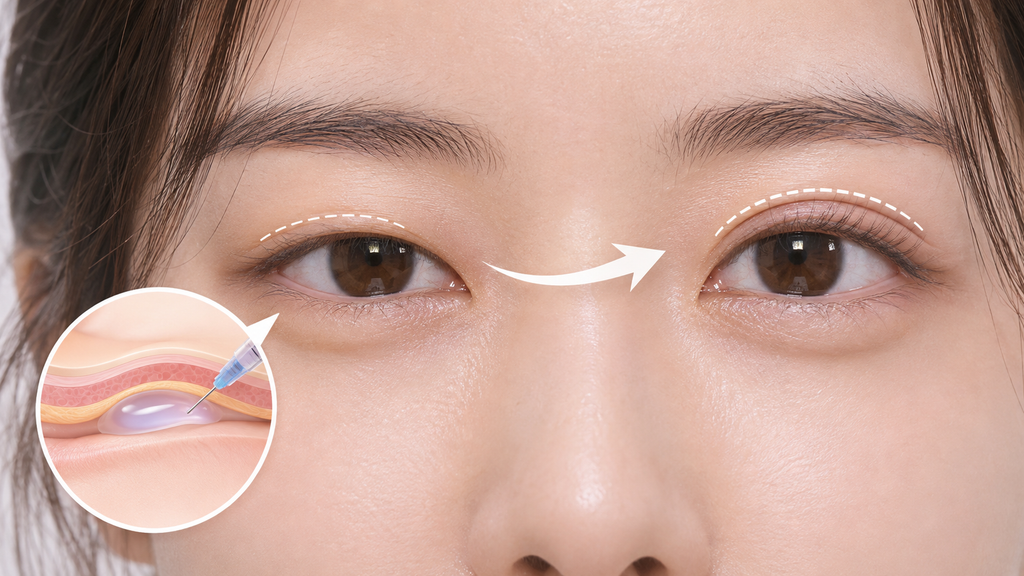
This leads some people to explore eyelid-crease filler in Gangnam.
However, a narrower crease on one side does not automatically mean that filler can make both sides match.
The appropriate approach depends on whether the eyelid has become hollow, the skin has sagged, or the function of the muscles that open the eye has changed.
Today, I will explain why one eyelid crease may become narrower, when filler may be considered for uneven-looking eyes, and what should be checked before treatment.
Key points at a glance
Q. Can filler balance uneven eyes when only one eyelid crease has become narrower?
A. If loss of eyelid volume is the cause, eyelid-crease filler may be considered to reduce the difference between the two sides. However, filler alone is unlikely to address sagging skin or a problem with eyelid elevation, such as ptosis. Before treatment, both eyelids need assessment of volume, skin condition and opening function. Perfect symmetry cannot be guaranteed.
1. Why does the crease on just one eyelid gradually become narrower?
An eyelid crease is more than a line in the skin.
It is shaped by several factors working together, including the connection between the eye-opening muscles and the skin, the distribution of eyelid fat, and skin thickness and elasticity.
Differences between the two eyes can therefore affect their creases.
Three main causes should be considered.
① Hollowness from reduced eyelid fat
The distribution of fat and the volume of soft tissues around the eyes can change with age.
As the upper eyelid becomes hollow, an existing crease may look different or develop multiple folds.
If volume loss is more pronounced on one side, the height and depth of the two creases may appear different.
A 2022 study in the Journal of Drugs in Dermatology also discusses the anatomical causes of upper-eyelid hollowness and approaches to restoring volume with hyaluronic acid filler.
② Sagging upper-eyelid skin
Looser eyelid skin can cover the existing crease.
In this situation, the crease itself has not necessarily disappeared; it looks narrower because the skin has descended over it.
Filler that replaces lost volume may not provide the desired change in this situation.
③ Changes in the function of the muscles that open the eye
A problem with the levator muscle or related structures can make one eye look relatively smaller or sleepier.
According to the Korea Disease Control and Prevention Agency’s National Health Information Portal, eyelid drooping can affect one or both sides, and treatment depends on the cause and levator function.
In particular, if you engage your forehead to open your eyes or an eyelid covers the pupil, it is important first to distinguish this from a cosmetic volume concern.
Uneven-looking eyes can therefore involve hollowness, sagging skin or impaired eyelid function, sometimes with more than one cause present.
2. When can eyelid-crease filler help with asymmetry, and when is it less suitable?
When considering eyelid-crease filler in Gangnam, the key question is not simply how different the two creases look.
What matters is whether filler can address the cause of that difference.
| Cause | Visible features | Possible approach |
|---|---|---|
| Eyelid hollowness | A hollow upper eyelid or multiple creases | Consider filler after assessing suitability |
| Sagging skin | Loose skin covers the eyelid crease | Assess the degree of sagging and whether surgery is indicated |
| Ptosis | Reduced eyelid-opening strength or less opening on one side | Functional assessment by an ophthalmologist or plastic surgeon |
| Combined causes | Hollowness and sagging occur together | Develop a treatment plan for each cause |
When eyelid hollowness is the main cause, replacing deficient volume to adjust the eyelid contour may be considered.
However, filler does not create a new eyelid crease or fix a crease at a chosen height.
The eyelid also has thin skin and moves frequently, so even small differences in volume can affect its appearance.
Not everyone with hollowness is therefore a suitable candidate. The treatment area, the product’s approved indications and the risks must also be checked.
3. Can filler be placed on only one side?
One common question about uneven-looking eyes is whether filler can be injected into only one eyelid.
The short answer is that treatment on one side may be considered when volume loss is clearly greater in that eyelid.
Even then, its relationship with the other eye needs to be assessed.
For example, imagine that the right eyelid is much more hollow than the left.
Replacing deficient volume on the right may help. However, differences in skin thickness and crease anatomy mean that matching volume alone will not produce identical creases.
Excessive filling can also make the eyelid look thick or make the crease less visible.
The priority is therefore not to inject equal amounts on both sides, but to assess the structure of each eyelid and the appropriate extent of change individually.
Filler around the eyes can cause rare but serious complications, including vascular occlusion and vision damage, so careful assessment of suitability must come first.
4. What should be checked before eyelid-crease filler in Gangnam?
Assessing uneven-looking eyes from a front-facing photograph with the eyes open is not enough.
It is necessary to examine the eyes both closed and open, forehead-muscle use, and the condition and volume of the eyelid skin.
The following points can be reviewed during a consultation.
- When the crease changed: Whether the eyes have always looked different or changed recently
- The degree of eyelid hollowness: Whether only one side is hollow or both sides have lost volume
- Eyelid-opening function: Whether you engage your forehead to open your eyes or an eyelid covers the pupil
- Previous procedures and surgery: Any history of eyelid surgery or filler around the eyes
- Changes during the day: Whether eyelid height differs between morning and afternoon
If eyelid drooping becomes worse in the afternoon or is accompanied by double vision or eye fatigue, medical causes such as neuromuscular conditions also need assessment.
If one eyelid suddenly droops, particularly with vision changes, a severe headache or different pupil sizes, prompt medical assessment takes priority over a cosmetic consultation.
This is why the same procedure cannot be applied to every case of uneven-looking eyes.
5. Understand the side effects before considering eyelid-crease filler
Eyelid skin is particularly thin, and the anatomy of this area is complex.
Filler treatment can cause swelling, bruising, pain, asymmetry, lumps and inflammation.
Rare but serious complications, including skin necrosis, vision damage and blindness, have also been reported following injection of filler into a blood vessel.
The U.S. FDA also warns about filler injections around the eyes and does not consider use in this area an approved indication. In Korea, the approved indications of the specific product being used must likewise be checked.
Even when replacing eyelid volume may be appropriate, it is important to make a careful decision after understanding both the possible changes and the risks.
Frequently asked questions (FAQ)
Q1. Will eyelid-crease filler make both eyes identical?
It may reduce differences between the eyes, but perfect symmetry cannot be guaranteed. Skin thickness, fat distribution, muscle function and the underlying skeletal structure differ between the two sides.
Q2. If only one crease has become narrower, can I have filler on that side alone?
Treatment on one side may be considered if volume loss on that side is the cause. Balance with the other eyelid, treatment suitability and risks must still be assessed together.
Q3. How does eyelid-crease filler differ from double-eyelid surgery?
Filler is an injection procedure that replaces deficient volume. Double-eyelid surgery creates a crease by adjusting connections or structures between eyelid tissues. Their purposes and suitable candidates differ.
Q4. Can filler help if drooping has made my eyes look uneven?
If sagging skin or a problem with levator function is the main cause, filler alone is unlikely to resolve it. The cause of drooping should first be identified so that appropriate treatment can be considered.
Q5. How long does eyelid-crease filler last?
Duration varies with the filler type, injection site and individual tissue condition. A specific duration cannot be guaranteed for everyone, and follow-up assessment may be needed after treatment.
If only one eyelid crease has changed, assess the cause before focusing on the line
Even a small difference around the eyes can change the overall impression of the face.
Differences in the height or depth of the creases may make one eye look particularly small or tired in photographs.
However, focusing only on adding volume without identifying the cause of asymmetry may lead to a gap between expectations and the actual result.
The first step is to distinguish eyelid hollowness from loose skin or a problem with eyelid-opening function.
Eyelid-crease filler is not a treatment for every form of eye asymmetry. It is an option that may be considered in selected cases involving loss of eyelid volume.
Plan Me Clinic’s approach to filler around the eyes
Even with similar concerns about eyelid creases, eyelid thickness, the degree of hollowness, skin elasticity and the way the eyes open differ between individuals.
Near Seolleung Station, Plan Me Clinic provides filler consultations that consider volume around the eyes and overall facial balance.
For Medical Director Seung-hwan Lee, the priority is not simply to fill a hollow, but to identify the cause of the change and assess an approach suited to the individual’s eye anatomy.
In areas such as the eyelids, where small differences in volume affect the overall impression, each eye needs individual assessment.
If filler is unsuitable, other causes and treatment needs should be assessed first rather than proceeding with an unnecessary procedure.
Our aim is to explain the need for treatment, possible changes, limitations and risks thoroughly, taking eyelid shape and individual anatomy into account.
If one eyelid crease has changed or you are concerned about uneven-looking eyes, have your current eyelid condition assessed before deciding on filler.
Plan Me Clinic | Medical Director Seung-hwan Lee
Near Seolleung Station · Eyelid filler · Eyelid-crease filler · Eye-area volume consultation
※ This content provides general medical information. Suitability and results vary with the individual. Side effects can include swelling, bruising, inflammation, vascular occlusion and vision damage. Filler around the eyes requires consideration of the product’s approved indications and assessment by an appropriately qualified clinician.