
 한국어
 English
 中文
 日本語
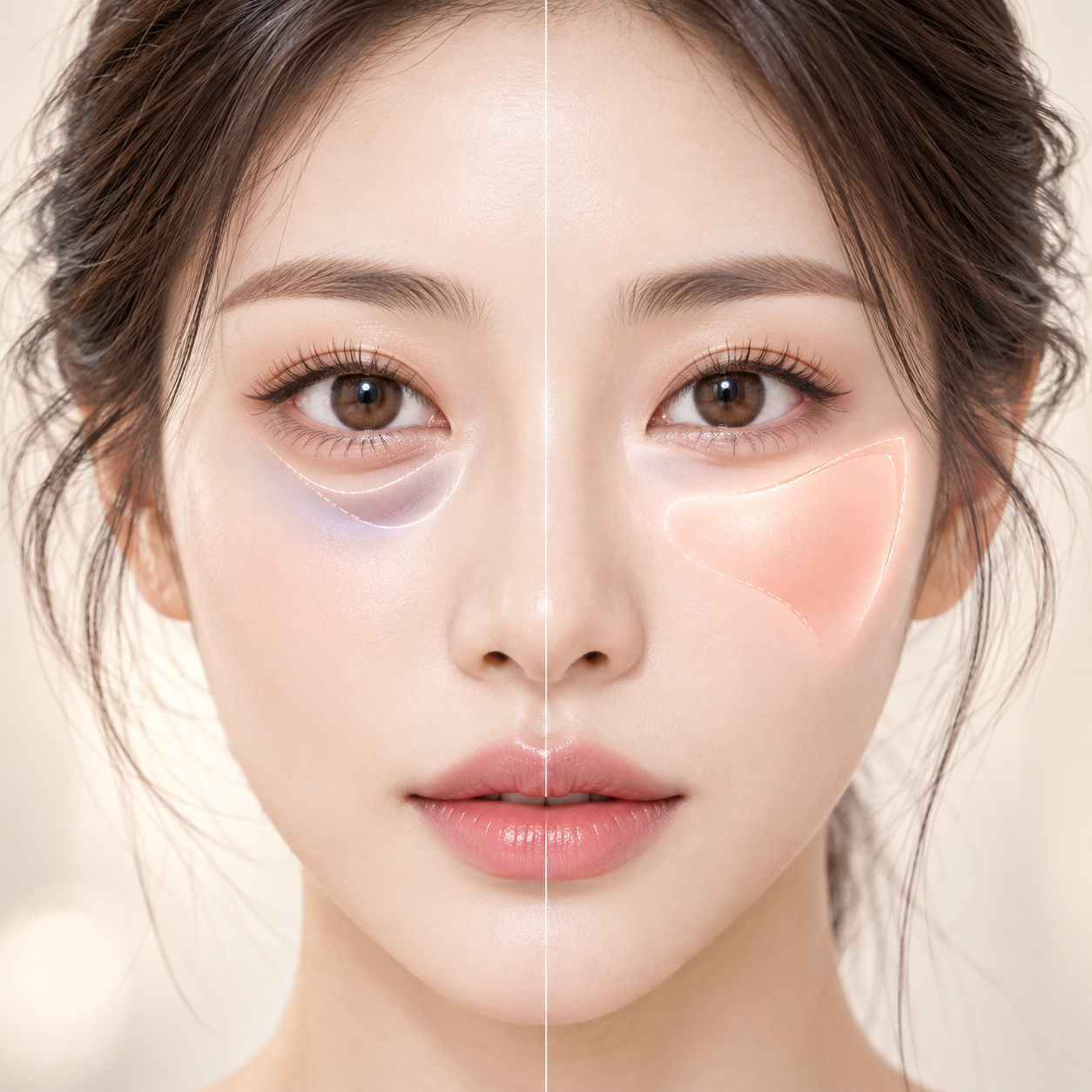
Some days, your under-eye area looks particularly hollow in photographs.
You may be told that you look tired despite getting enough sleep, or notice that a shadow remains beneath your eyes even after carefully applying concealer.
It is natural to start looking into under-eye filler. However, the reason your under-eye area looks hollow is not always located directly beneath the eye.
A loss of volume in the front of the cheek can also make the boundary between the under-eye area and cheek look deeper.
The main difference between under-eye filler and cheek filler is where volume is being replaced and why. Under-eye filler primarily addresses the tear trough and structural hollows beneath the eyes, while cheek filler involves assessing volume in the front of the cheek and the contour connecting the under-eye area to the cheek.
If you are considering under-eye filler in Seolleung, the first step is to identify where the hollow actually lies and what causes it before deciding which area to fill first.
1. Is under-eye hollowness really caused by a lack of volume beneath the eyes?
Key answer: Under-eye hollowness may reflect the structure of the tear trough itself, reduced cheek volume, protruding under-eye fat and skin condition, often in combination.
Beneath the eye is a structure called the tear trough.
This groove begins below the inner corner of the eye. Its apparent depth can vary with the attachment of the surrounding ligaments, fat distribution and skin thickness.
However, not every shadow you see beneath your eyes in the mirror comes from the tear trough.
The front of the cheek extends from beneath the eye toward the front of the cheekbone. A lack of volume here can make the boundary between the under-eye area and cheek more noticeable.
For example, a deep hollow immediately beneath the eye and a generally flatter front cheek can create a similarly tired appearance in photographs.
However, the approaches considered for these two situations are different.
A study published in 2024 on assessing under-eye dark circles also describes the importance of assessing central cheek volume and under-eye skin condition together, rather than examining the tear trough in isolation. PubMed
This is why an assessment should include how the surrounding tissues connect, as well as the under-eye area itself.
2. How exactly do under-eye filler and cheek filler differ?
Key answer: Under-eye filler is considered for structural grooves beneath the eye; cheek filler is considered for volume loss in the front of the cheek and the connecting contour.
Both treatments use filler to replace volume, but the areas assessed and the changes being considered differ.
| Feature | Under-eye filler | Cheek filler |
|---|---|---|
| Main area | Tear trough and under-eye boundary | Front of the cheek and the connection between the under-eye area and cheek |
| Main concern | Grooves beneath the eyes and structural shadows | Reduced cheek volume and a flat contour |
| Potential change | Softening a hollow under-eye boundary | Restoring cheek projection and the connecting contour |
| Limitations | Does not remove skin pigmentation or protruding fat itself | Does not directly address a deep tear trough or skin pigmentation |
| Points requiring care | Swelling, thin skin and existing filler | Existing volume, facial proportions and excessive volume |
This table provides a general explanation to help distinguish the two approaches.
In an actual face, volume loss can affect both the under-eye area and the front of the cheek, and treating only one area may not be appropriate.
The important question is which area of volume loss contributes most to your concern, rather than simply how much filler to use.
3. Is cheek filler sometimes considered before under-eye filler?
Yes. However, cheek filler is not the necessary first step for everyone.
If reduced volume in the front of the cheek makes the under-eye-to-cheek boundary more pronounced, the cheek may be assessed first before considering filler directly beneath the eye.
Although the under-eye area and front of the cheek may look like separate regions, they form one continuous facial contour.
If the front of the cheek is flat and only the under-eye groove is treated, the area beneath the eye may change while the contour leading into the cheek remains a concern.
Conversely, restoring cheek volume alone can sometimes make the under-eye boundary look less prominent.
A paper published in Aesthetic Surgery Journal Open Forum in 2025 describes the need to assess midface soft-tissue volume and skin condition together when evaluating under-eye hollowness. PMC
This does not mean that treating the cheek first is more effective in every case.
If the tear trough itself has a pronounced structural hollow, its boundary may remain even after cheek volume is restored. Conversely, adding unnecessary filler to a cheek that already has enough volume can create unwanted fullness.
Ultimately, the current facial structure matters more than a fixed treatment sequence.
4. A dark under-eye appearance does not always call for filler
Key answer: Dark circles can have several causes, including structural hollowness, pigmentation, visible vessels and protruding fat. Some cannot be addressed with filler alone.
When the under-eye area looks dark, hollowness is often the first explanation that comes to mind.
However, several factors can overlap to create that appearance.
- Structural shadows: shading caused by the tear trough and differences in surrounding volume
- Pigmentation: brown or gray discoloration within the skin itself
- Visible vessels: the color of blood vessels or muscle showing through thin skin
- Protruding fat: under-eye fat bulging outward and casting a shadow below it
- Skin laxity and swelling: skin condition or puffiness affecting the under-eye contour
A review of treatments for different causes of dark circles, involving researchers from Korea, also explains the need to distinguish these causes when choosing an approach. PubMed
Volume replacement may be considered when structural hollowness is responsible, but filler cannot remove pigmentation when the skin itself is dark.
In particular, filling a hollow when under-eye fat protrudes may make the area look more bulging or accentuate existing swelling.
When considering an under-eye filler consultation in Seolleung, establishing the cause comes before judging how severe the dark circles look.
5. When does under-eye filler require particular caution?
The skin around the eyes is thin, and blood vessels and other anatomical structures form a complex network.
The following situations require particularly careful assessment.
These include frequent under-eye swelling, remaining filler from a previous treatment or prolonged swelling afterward, pronounced protrusion of under-eye fat, and very thin or markedly lax skin around the eyes.
Repeated injections without checking for remaining filler can produce unexpected fullness or an irregular contour.
Filler treatment can also cause bruising, swelling, pain, asymmetry and nodules. In the under-eye area, a bluish appearance of the filler through the skin and persistent swelling can also be concerns.
Rarely, a blocked blood vessel can cause serious complications such as skin necrosis or vision damage.
The U.S. FDA does not include injections around the eyes among approved filler uses in the United States and warns of serious risks from injection into blood vessels. These are U.S. regulatory standards; in Korea, the Ministry of Food and Drug Safety approval information for the specific product must be checked separately. FDA
If sudden vision changes, severe unusual pain, or white or gray-blue skin discoloration occur during or after treatment, seek emergency medical care without delay.
6. What is assessed first at an under-eye filler consultation?
If you are deciding between under-eye and cheek filler, start by identifying the specific feature that concerns you most in the mirror.
The assessment differs depending on whether you notice a long line beneath the inner corner of the eye, flatness in the front of the cheek, or generally dark skin color.
A consultation may assess volume distribution in the tear trough and front cheek, protruding under-eye fat and swelling, facial contours from the front and at an angle, changes with facial expression, and previous filler or other treatments around the eyes.
If you have had filler before, it is helpful to share the product used, when it was injected and any changes you noticed afterward.
Further assessment of existing filler may be performed when necessary.
You should also receive a clear explanation of the product’s approved uses, the limits of the changes that can be expected, potential adverse effects and emergency response procedures.
A consultation may lead to a decision not to add filler, or to consider another treatment first.
7. Frequently asked questions
Q. If my under-eye area looks hollow, should under-eye or cheek filler come first?
It depends on whether the actual volume deficit is in the tear trough or the front of the cheek. If reduced cheek volume accentuates the under-eye boundary, the cheek may be assessed first, but the same sequence does not apply to everyone.
Q. Can cheek filler alone improve dark circles?
A visible change may be possible when a lack of cheek volume causes the shadow. However, it does not directly address darkness caused by pigmentation or visible vessels.
Q. Can filler be considered if my under-eye fat protrudes?
This depends on the degree of fat protrusion, surrounding hollowness and skin condition. Filler does not remove protruding fat, so another treatment may be more appropriate.
Q. Can I add cheek filler if I have already had under-eye filler?
Remaining filler, swelling and facial contours should be assessed first. Further treatment is not always appropriate when previous filler is still present.
Q. Does under-eye filler improve every cause of a tired appearance?
No. In addition to under-eye hollowness, pigmentation, protruding fat, skin laxity and other factors can contribute to a tired appearance.
Before adding under-eye volume, assess how the face connects
When the under-eye area looks hollow, our attention naturally goes straight to the groove beneath the eye.
However, no single area defines the whole face. The same concern may call for different approaches depending on how the under-eye contour connects with the front cheek, whether the skin itself is dark, and whether surrounding tissue has enough volume.
There is no fixed answer to whether under-eye filler or cheek filler should be considered first.
If you are exploring under-eye filler in Seolleung, it is helpful to have your current under-eye and cheek structure, previous treatments and desired degree of change assessed together.
At Plan Me Clinic, consultations assess the connection between the under-eye area and front cheek. The need for treatment and its appropriate extent are determined by an individual examination.
The priority is to understand what is actually causing your concern, rather than automatically adding more volume.
※ This article provides general medical information and does not guarantee the effects of any particular treatment. Filler can cause bruising, swelling, asymmetry and nodules, and, rarely, serious complications such as vascular occlusion, skin necrosis or vision damage. Suitability should be determined through a medical examination and review of the product’s approved uses.